Our Approach / Our Methodology
Our Methodology
A structured methodology for redesigning and continuously optimising complex clinical pathways.
Every clinical pathway is unique, but the challenges facing NHS organisations are remarkably consistent: rising demand, limited workforce capacity, fragmented information, increasing waiting times and growing pressure to deliver earlier intervention with finite resources.
The EnrichMyCare Clinical Pathway Transformation Methodology provides a structured, evidence-informed approach to understanding how a pathway currently operates, identifying where capacity is being lost, redesigning services around patient need, and embedding continuous optimisation through automation and AI-enabled clinical intelligence.
This is not a technology implementation framework.
It is a clinical pathway transformation methodology.
Healthcare transformation often focuses on introducing new technology into existing services. However, technology alone rarely solves pathway inefficiencies. Meaningful transformation begins by understanding the pathway itself:
Only once these questions are answered can technology become an enabler of sustainable transformation.
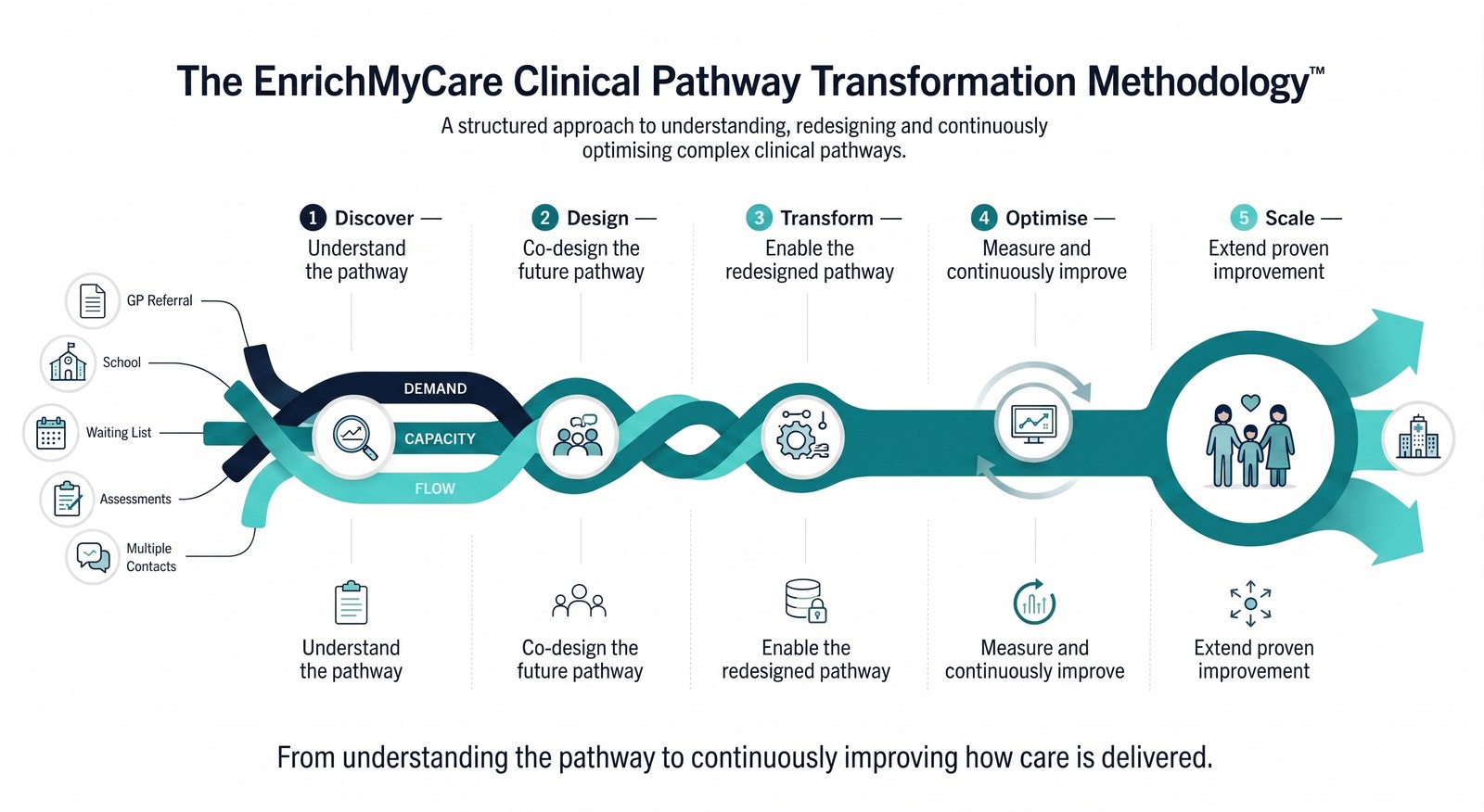
The methodology follows five connected stages, each building on the previous one while creating the foundations for long-term continuous improvement.
Understand the pathway before changing it.
Every transformation begins with developing a complete understanding of how the pathway currently functions. Working alongside clinicians, operational teams and service managers, we map the pathway from referral through to discharge, identifying:
The objective is not simply to create a process map. It is to understand where clinical capacity is being consumed and why.
Redesign the pathway around patient need.
Once the current pathway is understood, we work collaboratively to design a future-state service. Rather than digitising existing processes, we redesign them to remove unnecessary complexity and improve patient flow. Typical activities include:
Every proposed change is clinically governed and aligned with local service priorities.
Implement redesigned pathways safely and pragmatically.
Transformation is delivered in manageable stages rather than through large-scale system replacement. Depending on local priorities, implementation may include:
Technology supports transformation. It does not drive it.
Continuously improve pathway performance.
Transformation is not a one-off project. As services evolve, demand changes and clinical practice develops, pathways require continual refinement. Using real-world operational data, we help services monitor:
Insights generated through the platform allow services to identify improvement opportunities before problems become embedded.
Build a sustainable model for wider adoption.
Once a pathway has demonstrated measurable improvement, the methodology supports expansion across additional services and organisations. Because the methodology is structured and repeatable, it enables successful transformation to be replicated while respecting local clinical differences. Examples include:
The objective is not simply successful implementation. It is sustainable transformation at scale.
Unlike traditional implementation projects, the methodology does not end after deployment. Operational data, clinician feedback and pathway performance continually inform future redesign, ensuring services evolve alongside changing patient need.
Clinical pathways should improve continuously — not every five years.
Technology is an enabler — not the methodology.
The EnrichMyCare Platform supports the methodology by providing:
Technology delivers value because it is implemented within a structured transformation methodology.
Rather than focusing solely on software functionality, the methodology aims to support measurable improvements across the pathway.
The EnrichMyCare Clinical Pathway Transformation Methodology provides NHS organisations with a structured, clinically governed approach to redesigning services, embedding automation where appropriate, and supporting continuous optimisation through AI-enabled clinical intelligence.
Every transformation begins with understanding the pathway.
Every improvement is grounded in evidence.
Every implementation is designed to create sustainable change.
Ready When You Are
Backed by Oxford University Hospitals

Institutional shareholder in Enrich Digital Technologies Ltd.
Working Across the NHS, Academic & Innovation Ecosystem






Our Assurance and Recognition
Meeting the highest standards for safe, secure and effective NHS delivery.